Cornel West on Multiculturalism and Universality.

Unfortunately the image accompanying this post has been blocked by a new virus. It was an image of a strong African man holding a white child in his arms that may be found at: http://www.spiritualityhealth.com/shimages/vvimages/inamerica5.jpg
This image is found offensive by people, who also seem to find many of these posts offensive. We must not allow racists or antisemites to silence us. We must never give in to hatred or intimidation. It still amazes me that this image of an African-born man holding, loving and protecting a child is more disturbing to American officials than pornography.
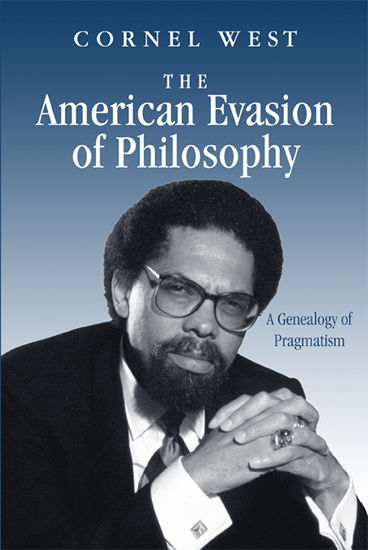
Cornel West, The American Evasion of Philosophy: A Genealogy of Pragmatism (Madison: University of Wisconsin Press, 1989), $19.95.
"The distinctive appeal of American pragmatism in our postmodern moment is its unashamedly moral emphasis and its unequivocally ameliorative impulse. In this world-weary period of pervasive cynicisms, nihilisms, terrorisms, and possible extermination, there is a longing for norms and values that can make a difference, a yearning for principled resistance and struggle that can change our desperate plight."
Western societies are burdened with an increasingly intense struggle over multiculturalism and a related concern to avoid the dangers of racial and ethnic factionalism and ideological division. We wish to see ourselves as members of families and communities, as citizens of nations and yet still members of a single species, nation, family and religous affiliation, striving to achieve peaceful coexistence with others in recognition of that shared humanity. We are uncertain about:
"... how we think of universality when it has been used as a smoke screen for a particular group. How do we preserve notions of universality given the fact that various other particularities -- traditions, heritages, communities, voices and what have you -- are moving closer to the center of the historical stage, pushing off those few which had served as the centering voices between 1492 and [1945?]"
Cornel West, "Diverse New World," in Debating P.C.: The Controversy of "Political Correctness" on College Campuses (New York: Dell, 1992), p. 327.
If we agree that one monolithic understanding of Western culture is unattractive or evil, that one understanding of what our responsibilities are, as human beings, is no longer plausible because it is too exclusive, then we should not feel obligated to discard the ideas of universality nor of cultural truth (especially complex ideas of such truth) in their entirety. We should not decide that all of the Western tradition is in need of revision or dismissal, or that we can do without it. We can not do without it. It is our tradition. It enriches us.
Race, ethnicity, sexual-preference and heritage matter -- but some things matter more. I suggest that the things which matter most are those which are fundamental and not parochial or trivial in our tradition. I believe that what unites us is more important than what divides us: decency, integrity, respect for human rights and the infinite and absolute moral worth of persons -- of all persons, regardless of race or class, religion or gender, or sexual orientation.
Skepticism about a single human nature, or an imperial conception of Western civilization, should not lead us to discard the unifying ideal of a "family of humanity," nor our need to identify with those who are externally different from us yet internally alike -- alike in frailty and suffering, and in the unwillingness to surrender freedom, as well as in the need for love.
In opposing "cultural imperialism" and all forms of racism, together with homophobia and sexism -- all of which I detest -- it should be clear that I do not wish to become a different sort of "politically correct" bigot. I have no desire to indulge in the mirror-image of those hateful attitudes that we have come to regard as benighted.
Hatred of whites is just as loathsome as hatred of blacks; antisemitism refers to the hatred of all semites, whether they are Muslims or Jews; religious intolerance is unacceptable when directed at any group; sexism in all of its forms is vile.
Professor West makes the point that we are all one species, one people, with a common genetic heritage and a shared ancestry, deriving from the material origins of the universe and from the emergence of human beings in the African plains. What is more, we are all made of that primal "stuff" of the universe. As a species, and this comes as a shock to racists, we have common ancestors in Africa -- as I never tire of explaining to racists -- despite our current physical differences.
This is to suggest that we give up the quest for "purity" of race or aristocratic pedigree. We must understand that, like it or not, we are in this situation together. We sink or swim together, as a species. We belong to one another, so that the great artistic and scientific achievements also belong to all of us, make us all richer, but may even be thought of as the collective creative achievements of all of us. ("Terry Tuchin, Diana Lisa Riccioli, and New Jersey's Agency of Torture.")
No, this is not to deny the contributions of individuals of genius. Yet we must not forget that there are necessary conditions to make, even the emergence of genius, possible. A great film maker born before the invention of the movie camera, will never become what he or she might have been. Persons denied basic education, something which happens to billions of human beings on the planet today, will never become the scientists, artists, or philosophers that they might become. This impoverishes all of us. No wonder they want to silence me for saying these disturbing things.
If one ultimate or fundamental human act is that of artistic creation, then each of us is a participant in that act when any of us engages in it, especially when creative effort leads to the very best results by the finest artists. Take pride in the achievements of Shakespeare, Mozart or Da Vinci, of Jane Austen or Paul Robeson, Cervantes or James Baldwin because they are also your achievements. Do not be misled by differences in ethnicity or skin color into believing that such a person's achievements can not be your own. The greatest cultural achievements are yours as much as anyone else's, they exist "for" you.
Artists create works and (appropriately) attach their own names to them. Nevertheless, works of art and all that they inspire belong to the tradition, finally, and to the culture and species. Plato's writings are now part of the cultural legacy of people living thousands of years after the philosopher's death, in a time and place that he could not have imagined. Those puzzling dialogues still live and inspire readers to ponder philosophical ideas, even in rejecting Plato's solutions. They are invitations to philosophizing that are all the more welcome because of their ability to assume a hybrid form today, for the new t.v.-reared subjects engaged in philosophical endeavor. They appeal to everybody. They should. They're great.
Let us admit that it is o.k. to say that much, regardless of whether Plato was male or female, straight or gay (and he probably was gay, though he would not have recognized the concept), and whatever the degree of darkness in the shade of his complexion. Let us be willing to recognize another great writer today, whatever his or her color, ethnicity, or economic class, without worrying too much about whether some are offended by the work this person produces. I doubt the quality of any work of art that is not found offensive by at least one person who comes into contact with it. Professor West points out:
"Europe has always been multicultural. Shakespeare borrowed from Italian narratives and pre-European narratives. When we think of multiculturalism, we're so deeply shaped by the American discourse of positively valued whiteness and negatively valued blackness, that somehow it's only when black and white folk interact that real multiculturalism is going on. ... But Europe is an ideological construct. It doesn't exist other than in the minds of elites who tried to constitute a homogeneous tradition that could bring together heterogeneous populations -- that's all it is."
Moreover:
"... In responding to these circumstances, the problem has been that most of us function by a kind of self-referential altruism, in which we're altruistic to those nearest to us, and those more distant, we tend to view as pictures rather than as human beings, we do have a common humanity. We must not forget our long historical backdrop. The present is history -- that continues to inform and shape our perceptions and orientations." (History that hurts?)
Debating P.C., pp. 324-325. ("Richard A. Posner on Voluntary Actions and Criminal Responsibility.")
And finally:
"The political challenge is to articulate universality in a way that is not a mere smokescreen for someone else's particularity. We must preserve the possibility of universal connection. That's the fundamental challenge. Let's dig deep enough within our heritage to make that connection to others."
Ibid., at p. 331 (emphasis added). ("Jacques Derrida's 'Philosophy as Jazz.'")
One of the things that acquisition of a tradition -- such as the Western philosophical tradition -- can do for us is to allow for a Sartre-like "totalization" of the reading experience, so as to construct a community of fellow readers or a "sharing-with" other students of the tradition. To philosophize, or just to read, is already an entry into the social, political, communal realities of our world. This is another important benefit of the classics: they provide us with instant community.
In my writings and in every attempt that I make to articulate my thoughts, I hope to engage the reader's attention and invite agreement, but I prefer to offend him or her rather than apathy or to produce the indifference of the banal and harmless sentiment contained in a greeting card. I hope to reach that center of value in the reader that is like mine, by reaching my own center of value. I hope to be human as opposed to merely male, Latino (whatever that means), ex-Catholic, socialist, heterosexual, but most of all I insist on being FREE.
Labels: Cornel West, Multiculturalism., Universality
posted by Juan Galis-Menendez @ 10:14 AM
0 comments